Quality control · Nairobi lab
Quality control, lot by lot
Every lot we offer is green-graded on a black tray, cupped blind by two Q graders and measured for moisture and water activity — once when it is offered, and again from the bagged lot before it is loaded. If it no longer matches the sample you approved, it does not travel.
Control points
Eight checks between the drying bed and the container
Quality control on a green coffee lot is not one cupping session at the end. It is a short list of measurements taken at points where the coffee can still be corrected, each one recorded against the lot number that later appears on your invoice.
| Checkpoint | What is measured | Threshold | Method |
|---|---|---|---|
| Cherry intake | Ripeness, floaters, foreign matter | ≥ 95 % ripe | Visual sort at the hopper and flotation in the receiving tank at the wet mill, on the day of picking. Unripes and floaters are separated into a lower lot, not blended back in. |
| Drying beds | Moisture in parchment | 10–12 % | Handheld Wile/Sinar meter, three points per bed, twice a day across the 7–15 days on raised tables. Beds are covered at midday and overnight. |
| Conditioning | Moisture and water activity after resting | 10.5–11.5 % · aw ≤ 0.60 | Water activity meter at 25 °C after 30+ days in conditioning bins. A lot that reads above 0.60 goes back to the store, not to the huller. |
| Hulling and screening | Screen retention after the huller | AA 17/18 · AB 15/16 · PB | Kenyan round-hole screens, 300 g sample shaken for 60 seconds. Retention below 90 % on the nominal screen sends the lot back over the sizer. |
| Density grading | Bulk density after the gravity table | 700–750 g/l | Gravimetric cylinder on a drawn sample. Light beans, shells and broken fragments come off the table as TT and are sold as TT — never returned to the AA or AB line. |
| Green grading | Full defects and colour uniformity | ≤ 5 / 300 g | SCA green grading protocol: 300 g at export moisture, hand-counted on a black tray under daylight-balanced light, category 1 and category 2 defects logged separately. |
| Cupping | SCA total score and cup faults | ≥ 84.00 | Five cups per lot, 8.25 g per 150 ml, blind, scored independently by two Q graders. One fermented or phenolic cup in five fails the lot outright. |
| Pre-shipment sample | Match to the sample you approved | Written approval | A 300 g sample drawn from the bagged lot is cupped against the sealed control sample and sent to you. No booking, no bill of lading until the approval email is in. |
In practice: a failed check sends the lot backwards, not forwards. Wet parchment goes back to the beds, a high defect count goes back through the sorting line, and a lot that will not cup to the profile it was offered at is re-offered at the grade it actually is — to somebody else.
Cupping
How a lot is scored
We score on the SCA cupping form: seven attributes rated from 6.00 to 10.00, plus sweetness, uniformity and clean cup at 10.00 each, less any defect deductions.
Sampling comes first, and it is where most of the honesty lives. Samples are drawn with a bag trier across at least 20 % of the bags in a lot, combined, quartered down and reduced to a 1 kg working sample. A lot sampled from three convenient bags at the front of the stack is not a lot that has been sampled.
Samples are roasted on a 100 g sample roaster to Agtron 58–63 whole bean, between 8 and 12 minutes, rested 8–24 hours and ground immediately before the session. Dose is 8.25 g per 150 ml at 93 °C, five cups per lot, evaluated at crust break and then repeatedly as the liquor cools to room temperature — most Kenyan defects only show themselves below 40 °C.
Two Q graders score blind with the lot code masked. Where the two totals sit within 2 points the scores are averaged; anything wider is re-cupped the next morning on a fresh roast before a number leaves the lab. The signed cupping sheet — attribute scores, descriptors, moisture, water activity and defect count — travels with the offer and again with the shipment.
The score is a release decision, not decoration. AA lots are released at 84.00 and above, anything under 80.00 leaves the specialty programme entirely, and the average across our AA lots this crop sits at 86.50.
- Sample roast
- Agtron 58–63
- Rest before cupping
- 8–24 h
- Dose
- 8.25 g / 150 ml
- Water
- 93 °C · 125–175 ppm
- Cups per lot
- 5
- Panel
- 2 Q graders, blind
- Form
- SCA · 100 points
- Release floor
- 84.00 for AA
Moisture · density · size
The measurements that decide how the lot travels
Cup score sells a lot. Moisture, water activity and density are what keep that score intact through six weeks at sea and however long the coffee then sits in your warehouse.
Moisture is held between 10–12 %. Below 10 % the coffee has been dried too fast and the cup goes flat and papery within weeks; above 12 % you are shipping water and inviting mould in a warm container. Readings are taken on parchment during drying, on green after hulling, and once more from the bagged lot at export.
Water activity is the more useful number of the two, because it measures free water rather than total water. We target 0.55 and treat 0.60 as a hard ceiling — the point at which mould growth becomes possible and shelf life starts to shorten measurably. Two lots can both read 11 % moisture and behave completely differently at 0.50 and 0.62 aw. The reference lot in our passport, LOT KE-25/NY-0147, shipped at 10.8 % and 0.55 aw.
Screen sorting and density grading come after hulling and before cupping. Size is graded on round-hole screens — AA on 17/18, AB on 15/16, peaberry off the shape sorter — and density on a gravity table, which is what actually separates a hard, high-grown bean from a light one of the same screen. Density is why an AA specification reads 700–750 g/l and not simply “large”.
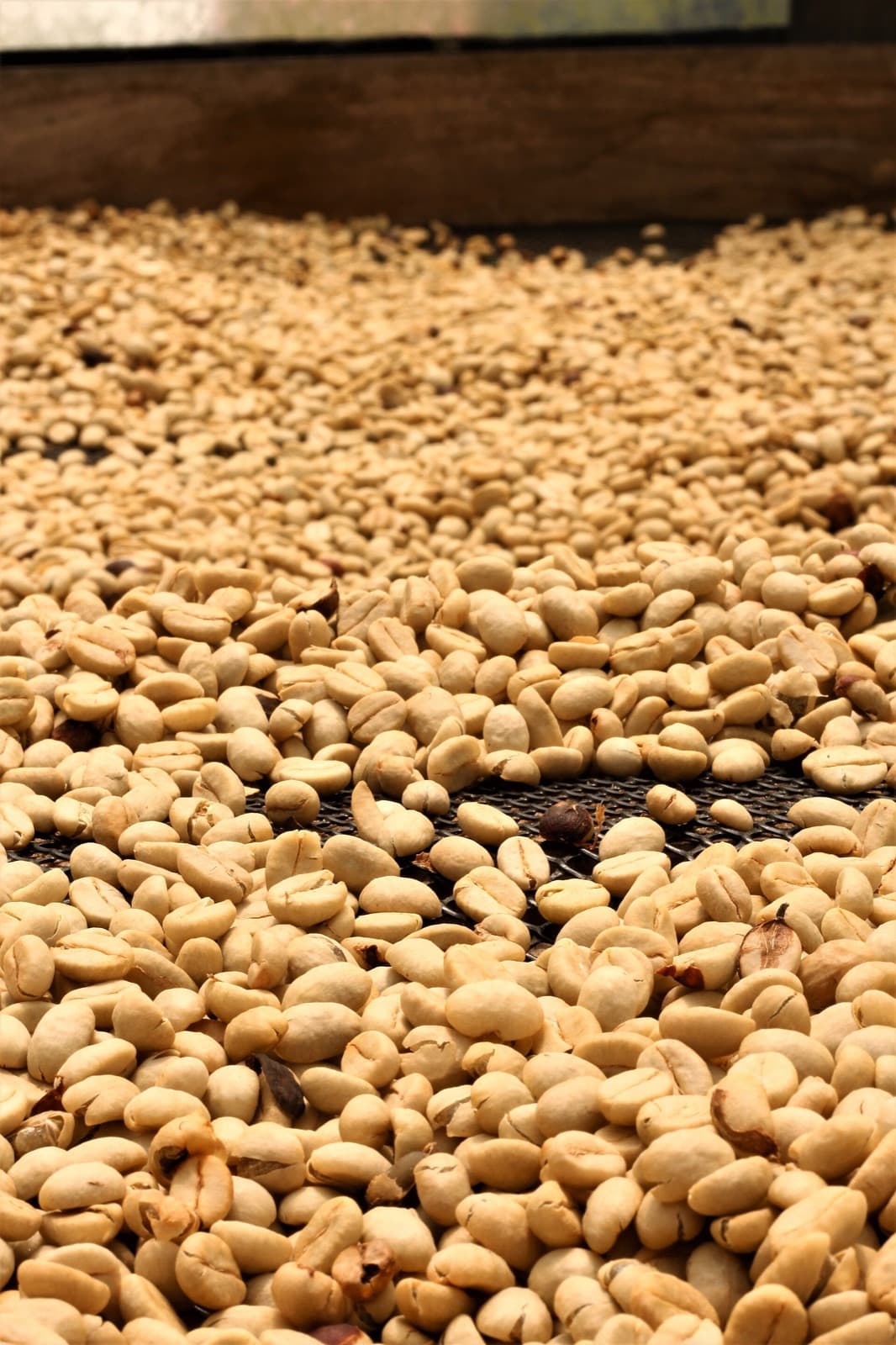
Green grading
Primary and secondary defects
Defects are counted, not estimated. A 300 g sample at export moisture is spread on a black tray and every defective bean is removed and classified. Category 1 defects are the ones that ruin a cup on their own; category 2 defects are tolerated in small numbers. Both are converted to “full defect” equivalents, which is the number that actually goes in the contract.
| Defect | Category | Beans per full defect |
|---|---|---|
| Full black | 1 | 1 |
| Full sour | 1 | 1 |
| Dried cherry / pod | 1 | 1 |
| Fungus damaged | 1 | 1 |
| Foreign matter (stone, stick) | 1 | 1 |
| Severe insect damage | 1 | 5 |
| Partial black | 2 | 3 |
| Partial sour | 2 | 3 |
| Parchment (unhulled) | 2 | 5 |
| Floater | 2 | 5 |
| Immature / quaker | 2 | 5 |
| Shell | 2 | 5 |
| Broken / chipped / cut | 2 | 5 |
| Slight insect damage | 2 | 10 |
Our release limit: a maximum of 5 full defects per 300 g and zero category 1 defects for any lot offered as specialty, against the 15 full defects the exchange standard would still let us call Grade 1. A single fermented, phenolic or mouldy cup on the table fails the lot no matter what the defect count says.
Approval
You approve the sample before we book the container
No lot is shipped on a description. Two samples cross your bench before anything is loaded, and both are cupped by you, on your roast profile, on your water.
Request a sample- Type sample — 300 g of the offered lot leaves Nairobi within 48 hours of the offer, with the cupping sheet, moisture, water activity and defect count for that specific lot number.
- Your approval in writing. You cup it, you decide, and nothing is booked before that email. Counter-samples are free and we would rather send three than argue about one.
- Pre-shipment sample (PSS) — drawn from the bulked, bagged lot, sealed and sent for the second approval. This is the sample the shipment is contractually matched against, not the type sample.
- A sealed control sample of every shipped lot stays in our Nairobi store for 12 months, so any question about a shipment can be cupped against the same coffee rather than argued from memory.
First sample of a season is at our cost. Air courier to Moscow or St Petersburg runs 7–10 days; sample lots up to 30 kg move the same way when you need enough to run a real production roast.
Non-conformance
What happens when a lot misses its profile
Occasionally a lot moves between the type sample and the pre-shipment sample — a slow patch of drying weather, a wet mill that changed fermentation time, a bulking that pulled in one bad day of cherry.
When that happens we tell you before you find out from the container. The pre-shipment sample is re-cupped by both graders, checked against the retained control sample, and the deviation is written down as a number: attribute by attribute, moisture, water activity and defect count.
What we do not do is ship it and negotiate afterwards. A discount on a coffee that will not perform in your roastery costs you more than the shipment is worth, and it costs us the account.
- It is not shipped
A lot that no longer matches the sample you approved does not leave the warehouse under that contract. We select lots on cup results, not on what is left in the store.
- You get a replacement, not an argument
The remaining lots from the same wet mill are re-cupped that week and a replacement is offered at the contracted grade and price. If nothing matches, we say so and release you from the volume instead of substituting quietly.
- Retained samples settle claims
Every claim is cupped against the sealed control sample from the same lot — by us, and by a third-party lab in Nairobi or at destination if you want one. Whoever turns out to be wrong pays for the cupping.